
Ask how much a 3D printed home saves and you will get answers ranging from 10 percent to 50 percent. Both numbers can be true, depending on what is being measured and where. For an investor, the useful skill is knowing which figure applies to your situation. Let us take the cost structure apart.
Start With Cost Per Square Foot
The headline number most people reach for is cost per square foot. For printed construction in 2025 and 2026, industry estimates commonly land between 80 and 200 dollars per square foot. That is a wide range, and the spread tells you something important: the printer is only one input among many. Design complexity, location, finish quality, and local labor rates move the number as much as the technology does.
A simple, boxy single-story home sits at the low end. Add curves, multiple stories, high-end finishes, or an expensive market, and you climb toward the top. This is true of conventional building as well, which is the first clue that a printed home is still a home first and a printed object second.
The 15 to 30 Percent Rule
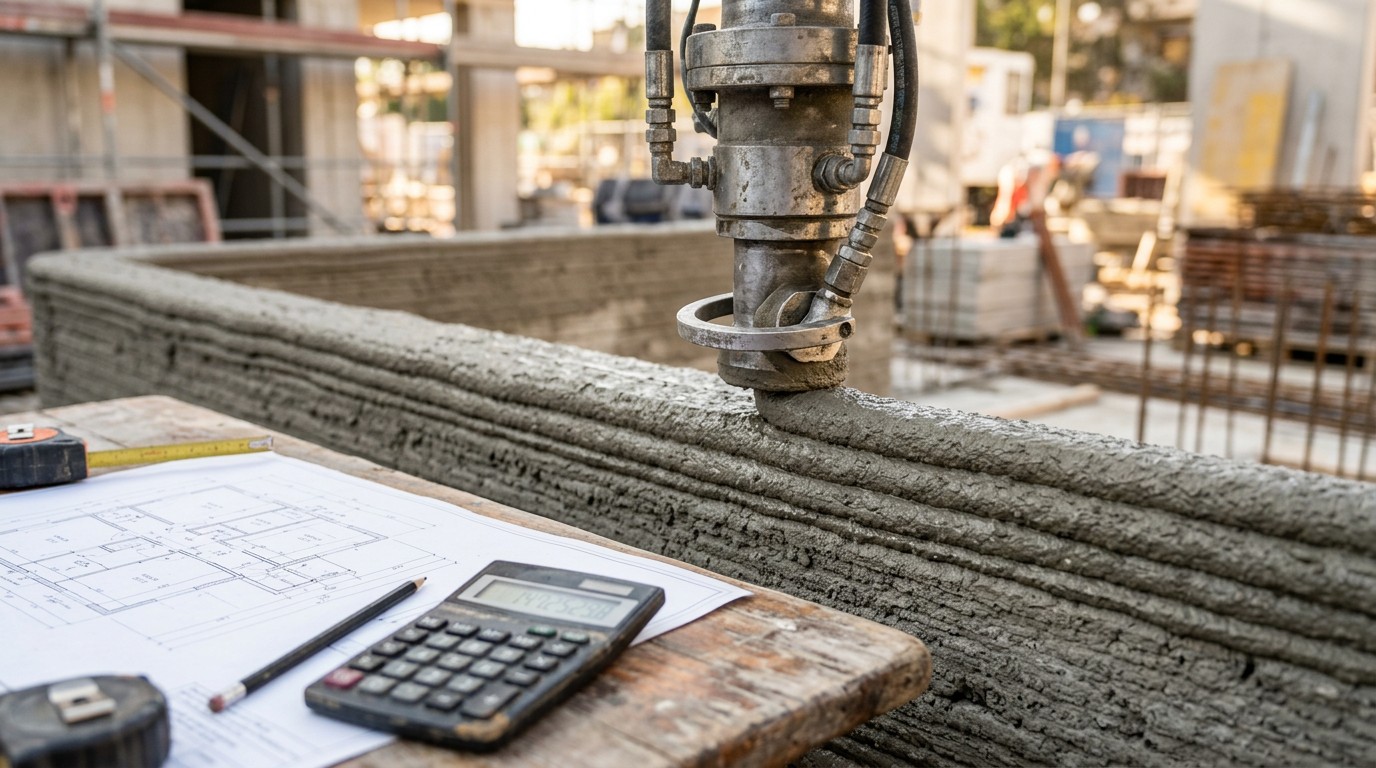
Here is the single most useful fact in this article. Printing the structural shell, meaning the walls and sometimes the floor, typically accounts for only about 15 to 30 percent of a home's total construction cost. Printing that shell might run somewhere in the range of 10,000 to 35,000 dollars on a modest home.
Everything else, the foundation prep, roofing, plumbing, electrical, HVAC, windows, doors, and interior finishes, still gets built the traditional way at traditional prices. That is why a printer cannot cut a home's total cost in half by itself. It can only work on the slice of the budget it actually touches.
So Where Do the Real Savings Come From
Two places, mostly. The first is labor. Because the machine does the heavy structural work, some projects report cutting labor hours on that phase by as much as 70 percent, and running with a crew of 3 to 4 instead of 10 to 15. In a market where skilled labor is scarce and expensive, that saving is real and it grows with the local wage rate.
The second is material efficiency. Printing places concrete precisely where the design calls for it, which can cut material waste substantially, with some operations reporting reductions of up to 60 percent and lower concrete use compared to conventional forming. Less waste means lower material spend and lower disposal costs.
Put those together and the overall savings on a finished home today commonly fall in the 10 to 30 percent range, concentrated in high-labor markets. Some analysts project that as printers get cheaper and codes standardize, overall reductions could reach 30 to 40 percent in expensive-labor regions later this decade. Those are projections, not guarantees, and a careful investor treats them as such.
The Costs That Do Not Show Up in the Brochure
Savings are only half the ledger. Printed projects carry expenses that conventional builders do not always face. Engineering reviews and stamped plans for a newer method can cost more. Material testing, longer permitting cycles in jurisdictions without clear printed-home codes, and specialty insurance all add up. For a developer, there is also the printer itself, which is a major capital outlay we will cover when we discuss scale.
None of these are dealbreakers. But they explain why the savings on paper do not always survive contact with a real project, especially a first one. The learning curve is expensive, and it flattens with volume.
How to Read a Cost Claim
When someone quotes you a savings figure, ask three questions. Compared to what baseline, in what market, and does the number describe the shell or the whole home? A 40 percent saving on the wall system is not the same as a 40 percent saving on the house. A dramatic figure from a high-wage market may not repeat in a low-wage one.
The Bottom Line
Printed homes do save money, but the savings are specific rather than magical. They live in the labor and materials of the structural shell, they are largest where labor is expensive, and they are partly offset by the added costs of a young technology. Model your project on the 15 to 30 percent slice the printer actually affects, keep the finishing trades in full view, and your numbers will hold up. In the next article, we look at a saving that is easy to overlook and often more valuable than the construction cost itself: time.