
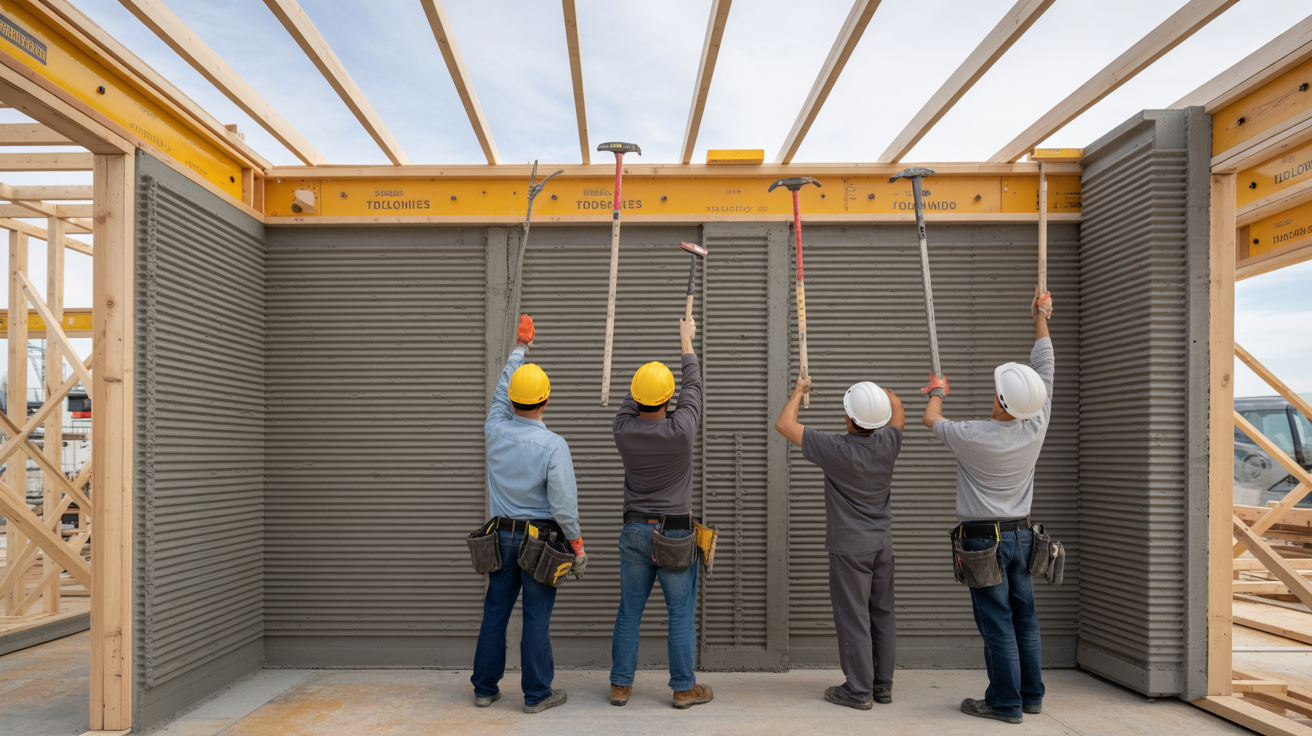
For most contractors, framing is where a project really begins to take shape. The rhythm of it is familiar: layout, plates, studs, headers, sheathing — a process that's been refined over decades into something efficient and predictable. So when someone tells a framing crew that a robot is going to handle the walls, the natural reaction is skepticism. That skepticism is fair. But the full picture is more nuanced than "robots are taking over," and for contractors willing to understand what's actually changing, there's real opportunity here.
What the Printer Actually Does
In large-scale concrete 3D printing (the kind used by companies like ICON and CreteBots), a gantry or robotic arm system moves along a set of rails, extruding a specially formulated concrete mixture in continuous layers. Each pass builds on the last, creating hollow-cavity walls that are dense, precise, and structurally sound. A typical bead of material is roughly 2.5 inches wide, with internal voids of around 7 inches that can later be filled with foam insulation or used as chases for utilities.
For a small single-story home, the exterior and primary interior walls can be printed in as little as 24 to 72 hours of active print time. The printer follows a CAD file, meaning the design is locked in digitally before a single layer is laid. Door and window openings are printed directly into the walls. Load-bearing columns and control joints are incorporated into the design. When the printer finishes, you have a shell that would have taken a framing crew days or weeks to build by hand.
What It Means for Framers
Here's the honest reality: the traditional framing role for exterior walls is significantly reduced on a 3D printed project. A print crew typically runs three to five workers (operators, material handlers, and supervisors) compared to the five to twelve workers a conventional framing crew might deploy for the same scope. That's a meaningful reduction in labor hours for that phase.
However, framing doesn't disappear. Current printing technology is generally limited to single-story wall heights — ICON's systems, for example, top out at around 12.5 feet. That means upper floors, interior partition walls, stair structures, and roof framing still require traditional stick framing. On a two-story home, a framing contractor might handle everything above the first-floor printed shell using completely conventional methods.
The result is a hybrid workflow. Framers who adapt to working alongside printed shells — understanding how to tie into concrete walls, how to anchor top plates, how to sequence their work around the print schedule — will find steady work on these projects. Those who resist learning the hybrid model may find themselves on the outside looking in as more builders adopt the technology.
The Sequencing Shift
One of the more significant changes for framing contractors is how the job site schedule changes. In traditional construction, framing is the critical path — everything else waits for it. In a 3D printed project, the shell arrives faster, which means other trades are ready to move in sooner. That's good for the overall project timeline, but it requires tighter coordination. Framers completing upper-floor and partition work need to be ready to move quickly once the printed shell is cured and inspected.
For contractors running multiple projects, this faster shell completion is actually an advantage. A framing crew that would have spent three weeks on a conventional exterior shell can now redirect that capacity to another job while the printer handles the ground-floor walls. The math on crew utilization starts to look considerably different, and more favorable, when you factor that in.
The Bottom Line for Framing Contractors
The stud wall isn't dead. But its role is changing, and the change is accelerating. Contractors who invest time in understanding how printed shells are designed, how they're tied into foundations, and how hybrid framing integrates with them will be better positioned than those who wait. The technology is still maturing — not every market has adopted it, and building codes in many jurisdictions are still catching up. But the direction is clear, and the contractors who get ahead of it now will have a meaningful edge when it becomes the norm.
Coming Next Week
Once the shell is up, the roof is next. In Part 2, we look at how roofing contractors fit into 3D printed construction — what changes, what stays the same, and why ICON's new Phoenix printer is the one technology roofers should be watching closely.