
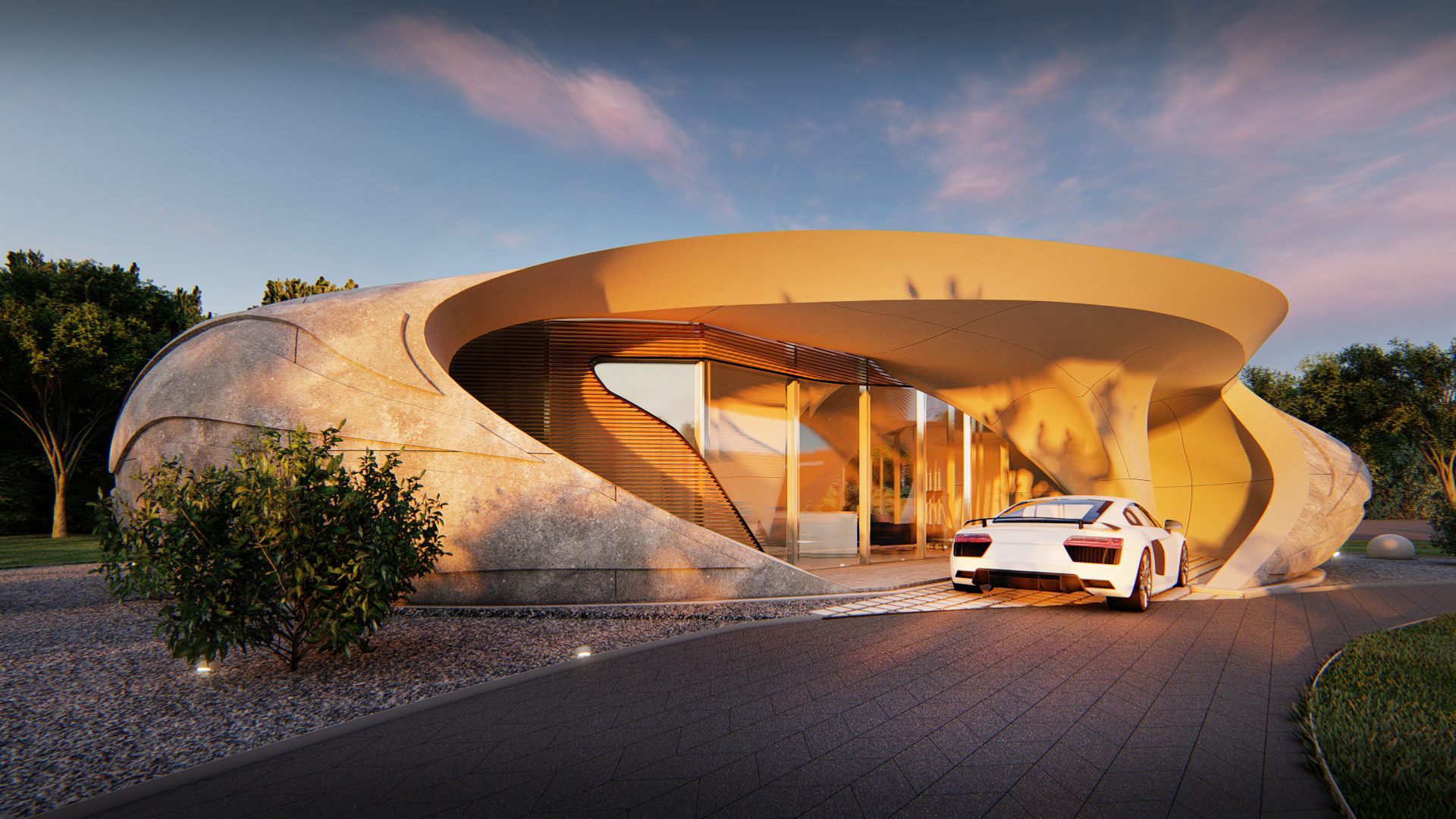
For most of history, building a home meant working within a set of constraints. Straight walls were easier and cheaper. Standard room sizes made framing simpler. Unusual shapes or custom features cost extra — sometimes a lot extra. The economics of traditional construction pushed homes toward uniformity, and that's a big part of why so many subdivisions end up looking nearly identical.
3D printing is changing that equation in ways that are genuinely exciting for anyone who's ever wanted a home that felt truly personal.
Curves Are No Longer a Luxury
In traditional construction, curved walls are a headache. They require custom framing, extra labor, and careful planning — all of which add cost. In 3D printing, a curve is just a different set of coordinates in the software. The machine doesn't care whether it's printing a straight line or a sweeping arc. The cost difference is minimal.
This opens up a world of design possibilities that were previously reserved for high-end custom homes. Rounded rooms, organic shapes, flowing transitions between spaces — these are all achievable with 3D printing at a price point that's accessible to average buyers. Architects are already exploring what this means for residential design, and the results are striking.
Custom Layouts Without Custom Prices
Beyond curves, 3D printing allows for highly customized floor plans without the premium that customization usually carries. Because the home is built from a digital file, changing the layout is largely a matter of changing the file. Want a wider hallway? An extra nook? A uniquely shaped bedroom? These kinds of modifications are far more practical in a 3D printed build than in a traditionally framed one.
This is particularly meaningful for buyers with specific needs — whether that's accessibility features for a family member with mobility challenges, a dedicated workspace built into the design from the start, or simply a layout that reflects how a particular family actually lives rather than how a developer assumed they would.
AI and Robotics: The Design Partners of the Future
The integration of artificial intelligence into the design and printing process is accelerating what's possible. AI tools can optimize a home's design for structural integrity, energy efficiency, and material use — all at the same time. They can generate dozens of design variations in minutes, allowing buyers and architects to explore options that would have taken weeks to draft by hand.
Robotic systems are becoming more precise and more capable with each generation. The printers being used today are significantly more advanced than those used just five years ago, and the pace of improvement shows no signs of slowing.
Luxury Meets Innovation
It's worth noting that 3D printing isn't only being used for affordable housing. ICON, for example, has built a luxury home at Lake Travis in Texas that showcases what the technology can do at the high end of the market — sweeping architectural forms, premium finishes, and a design that would be extraordinarily difficult to achieve through conventional construction.
This matters because it demonstrates the full range of what 3D printing can produce. It's not a technology that's limited to basic, utilitarian structures. It's a platform for genuine architectural creativity — one that's becoming more accessible to more buyers every year.
For anyone who's ever looked at a cookie-cutter subdivision and thought "there has to be something better," 3D printed housing offers a compelling answer. The home of the future doesn't have to look like every other home on the block. And increasingly, it doesn't have to cost a fortune to be something truly your own.