
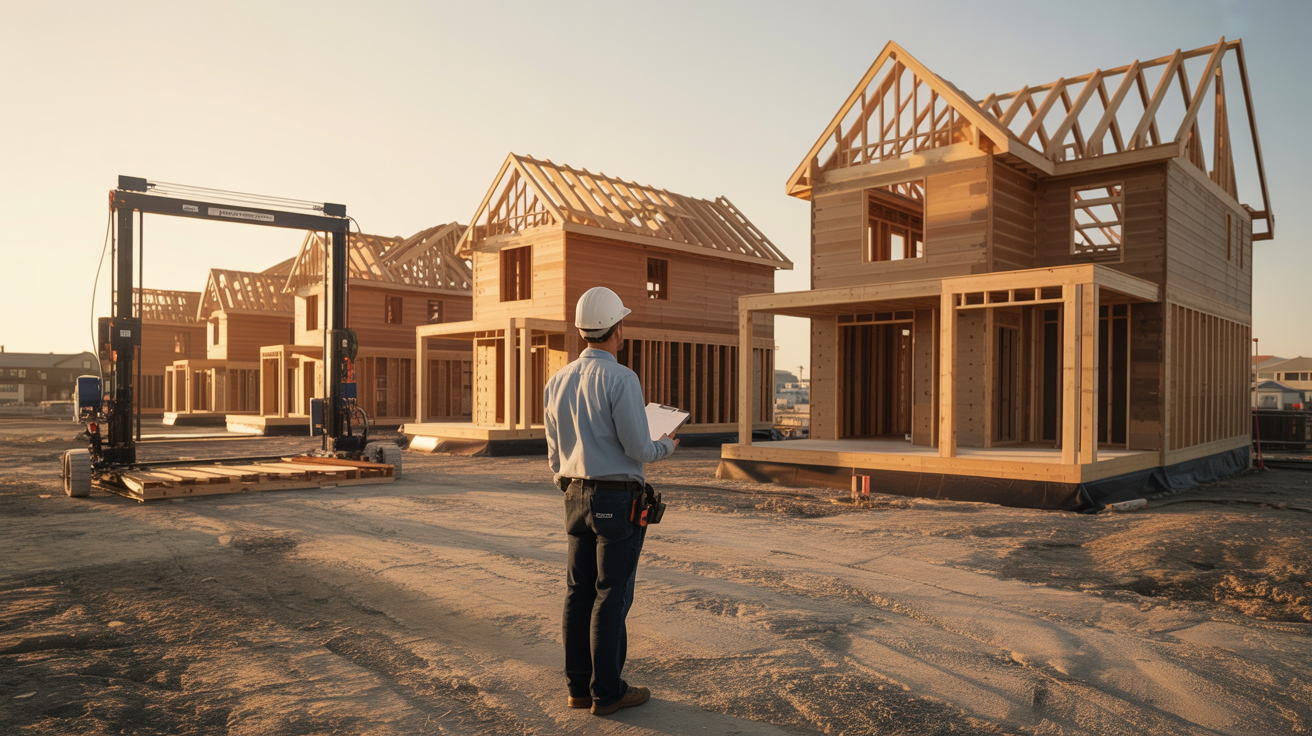
Every contractor knows the feeling. You've got a crew ready to work, but the job site isn't ready for them. Maybe framing is running behind. Maybe an inspection got delayed. Maybe materials didn't show up on time. Whatever the reason, your people are standing around, or worse, you've had to send them home, and the clock is running on your overhead. Downtime is one of the most persistent and frustrating realities of the construction business, and it's one that 3D printing has a real shot at reducing.
The Speed Advantage Compounds
The core reason 3D printing helps with contractor scheduling is simple: the structural shell is completed dramatically faster. What takes a framing crew one to three weeks in conventional construction takes a print crew one to three days of active print time. That compression at the front end of the project creates a cascade effect: every trade that follows gets to start sooner, which means every trade finishes sooner, which means the project closes out faster.
For a contractor running multiple projects simultaneously, this matters enormously. A plumber who would have spent two weeks waiting for framing to be complete on a conventional project might be on-site doing rough-in work within days on a printed one. That freed-up time doesn't disappear; it gets redirected to another job. The same crew, the same tools, more projects completed per quarter.
Parallel Scheduling Becomes More Realistic
In traditional construction, the critical path is long and sequential. Foundation, then framing, then rough-ins, then insulation, then drywall — each phase largely waiting for the previous one to finish. The result is that subcontractors spend a lot of time in a queue, waiting for their turn on a job that's moving at the pace of its slowest phase.
3D printed construction compresses the early phases so significantly that parallel scheduling — running multiple projects in overlapping stages simultaneously — becomes much more practical. A GC managing a portfolio of printed home projects can stagger print starts so that while one home is in the rough-in phase, another is being printed, and a third is having its foundation poured. The trades rotate through each project on a tighter, more predictable schedule.
This isn't theoretical. Builders like ICON and their partners have demonstrated exactly this kind of parallel workflow at developments like Wolf Ranch, where multiple homes were in various stages of completion simultaneously. The result was a development that delivered homes faster than a sequentially built conventional subdivision of the same size could have.
Predictability Is as Valuable as Speed
One underappreciated benefit of 3D printed construction for contractors is predictability. The print process follows a digital file. It doesn't get sick, doesn't have bad days, and doesn't make the kind of field errors that require rework. When the printer finishes, the walls are where they're supposed to be, the openings are the right size, and the dimensions match the drawings.
For subcontractors, this means fewer surprises when you show up to do your work. Plumbers aren't finding walls in the wrong place. Electricians aren't dealing with framing that doesn't match the electrical plan. HVAC contractors aren't discovering that the mechanical chase was framed two feet off from where it was supposed to be. That reduction in rework and problem-solving time adds up to real hours saved across a project, and real dollars saved across a business.
The Business Case for Subcontractors
Let's put some rough numbers around this. If a subcontractor typically completes eight residential projects per year on a conventional construction schedule, and 3D printed projects run 30 to 40 percent faster through the phases where that sub is active, the math suggests the same crew could potentially complete ten to eleven projects per year on printed home work. That's a 25 to 35 percent increase in revenue capacity without adding a single person to the payroll.
Those numbers will vary based on trade, market, and project type. They're not a guarantee. But they illustrate why contractors who get established in the 3D printed home market early — who build relationships with the GCs and builders doing this work, who train their crews on the specific requirements of printed construction — are positioning themselves for a solid competitive advantage.
The Learning Curve Is Real, But Short
It would be dishonest to suggest that the transition to working on printed home projects is seamless. There's a learning curve. Sequencing is different. Coordination requirements are higher. The first project will take longer than the fifth, because your crew will be figuring things out as they go. That's true of any new construction method.
But the curve is not steep, and the payoff on the other side is clearly visible. Contractors who have made the transition consistently report that by the second or third printed home project, their crews are moving efficiently and the scheduling advantages are meaningfully apparent. The investment in learning is modest. The return, in reduced downtime and increased project throughput, is substantial.
The Bottom Line
Downtime costs money. Waiting costs money. Inefficient scheduling costs money. 3D printed construction doesn't eliminate these problems entirely — no technology does — but it attacks them at the source by compressing the phases that create the most waiting. For contractors who are tired of watching their crews stand around while a conventional framing job drags on, the printed home market offers something worth paying attention to: a faster clock, a more predictable schedule, and the real possibility of doing more work with the same resources.
That's not hype. That's math.
The Series Continues
That wraps The Contractor's Series — seven weeks of practical, trade-by-trade thinking on what 3D printed construction means for the people who actually build these homes. Keep an eye on the Insights page for the next series, and if you missed any of this one, the full archive is right there in the sidebar. The contractors who get ahead of this early will be the ones who shape how the trade adapts.