Most 3D printed construction stories are about homes. This one is about a retail building, and that difference is the point. When Walmart, the largest retailer in the country, uses printed construction for real infrastructure, it tells the rest of the market that the technology is ready for everyday commercial work.
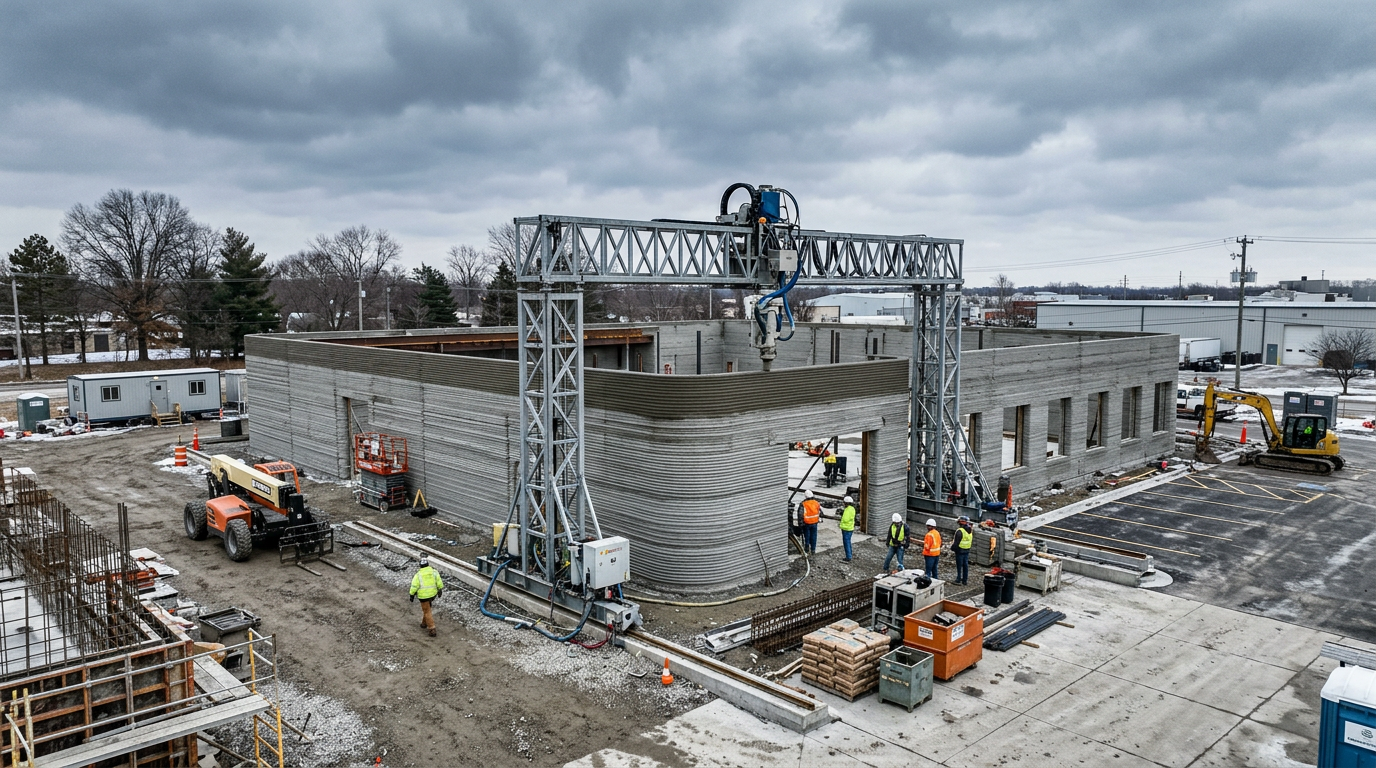
The project sits in Lamar, Missouri, where Alquist 3D printed a 4,400 square foot commercial structure for Walmart. It is the third Walmart building Alquist has printed, following earlier projects in Athens, Tennessee and Owens Crossroads, Alabama. Together they form the backbone of a plan to bring printed construction to retail sites across the United States.
Building through a Missouri winter
The headline number is speed. The actual printing took 17 days, with 19 days on site once quality and safety checks were included, and the printer ran for 71.3 hours to complete the shell. The team had planned for 69 hours, so the job finished at 103 percent of the estimate, which is remarkably close for a build of this size.
What stands out more is the weather. Crews printed in temperatures as low as 24 degrees Fahrenheit, with high humidity, conditions where traditional concrete masonry work would usually stop. The building reaches a print height of about 18 feet 8 inches, and the process held up through cold that would have idled a conventional crew.
Less waste, more predictability
Alquist reported a material waste factor of roughly 9 percent, using 98.9 units of material against a 99-unit projection. For a first-generation technology, hitting the material plan that closely is a sign the process is maturing from experiment to routine.
A new business model behind the build
The more interesting story may be how the project was financed and equipped. Rather than owning every printer itself, Alquist worked with a general contractor, FMGI, that owns and leases the A1X robotic printers, and with equipment dealer Hugg & Hall, which provides financing, maintenance, and service for the printer fleet.
That structure is what makes a nationwide rollout realistic. It spreads the cost of the machines across a leasing and service model that the construction industry already understands, instead of asking one company to carry every printer on its own books.
What comes next
Walmart and Alquist have signaled plans for more than a dozen additional printed projects. The Lamar building is best understood as a proof point for repeatable commercial work: a defined size, a known print time, a predictable material budget, and a supply chain that can be copied from one site to the next.
Why it matters
For the wider industry, commercial adoption by a company the size of Walmart does something no housing pilot can. It normalizes printed construction for lenders, inspectors, and suppliers, and that groundwork tends to make the next residential project easier to finance and approve.