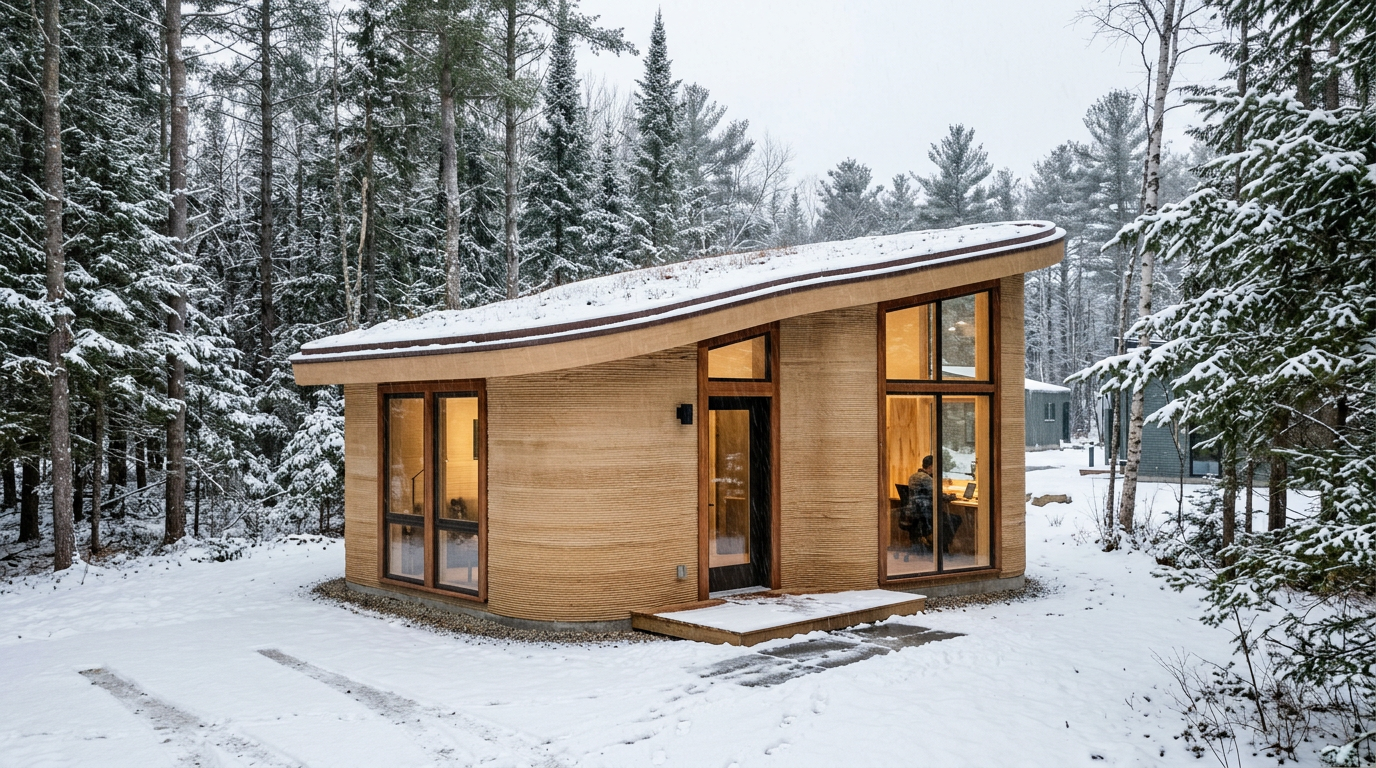
Almost every 3D printed home shares one ingredient: concrete. The University of Maine set out to prove that a printed house could be made from something renewable instead, and the result is BioHome3D, a 600 square foot prototype printed from wood fibers and bio-resins rather than cement.
Developed at the university's Advanced Structures and Composites Center, it was unveiled in late 2022 as what the team describes as the first house 3D printed entirely from bio-based, recyclable materials. Floors, walls, and roof all came off the printer using the same wood-based feedstock.
A house made from the forest
The feedstock is built around locally sourced wood fibers, a natural fit for Maine's forest-products economy, combined with bio-resins. Insulation is wood-based too, using a mix of wood fiber and blown-in cellulose that lets the team tune the R-value to the climate.
Because the whole structure is bio-based, it is fully recyclable at the end of its life, which is something no concrete home can claim. The prototype was printed on what the center describes as one of the largest polymer 3D printers in the world, in an automated off-site process that produced almost no construction waste.
Fast to assemble
BioHome3D was printed in four modules, trucked to the site, and assembled in about half a day. The electrical system was operational within two hours of assembly and needed only one electrician on site. For regions facing labor shortages, that kind of speed and simplicity is a large part of the appeal.
Built to be studied
The prototype sits on a foundation outside the research center, wired with thermal, environmental, and structural sensors. Through Maine's hard winters, the team collects performance data to refine future designs, so the house is as much a long-running experiment as a demonstration.
The project came together through the U.S. Department of Energy's Hub and Spoke program, a collaboration with Oak Ridge National Laboratory, alongside partners including MaineHousing and the Maine Technology Institute.
Why it matters
BioHome3D is a prototype, not a product you can order today, and it is fair to treat it that way. Its importance is in the direction it sets. It shows that printed housing does not have to depend on cement, one of the most carbon-intensive materials in construction, and that a renewable, recyclable home is technically possible. For buyers thinking years ahead, it is a preview of where the greenest end of this industry may be heading.